What’s Your Favorite App and Why?

The #100percentdigital faculty-staff learning community got off to a great start last week with the Apps and Appetizer Mixer.  Thanks to all of you who joined us.  I learned a lot from both the full group discussion and smaller conversations about what the best apps are and why.  Below is a word cloud showing the results of our live poll using Poll Everywhere, which lets participants respond via text message or web page from any mobile device:
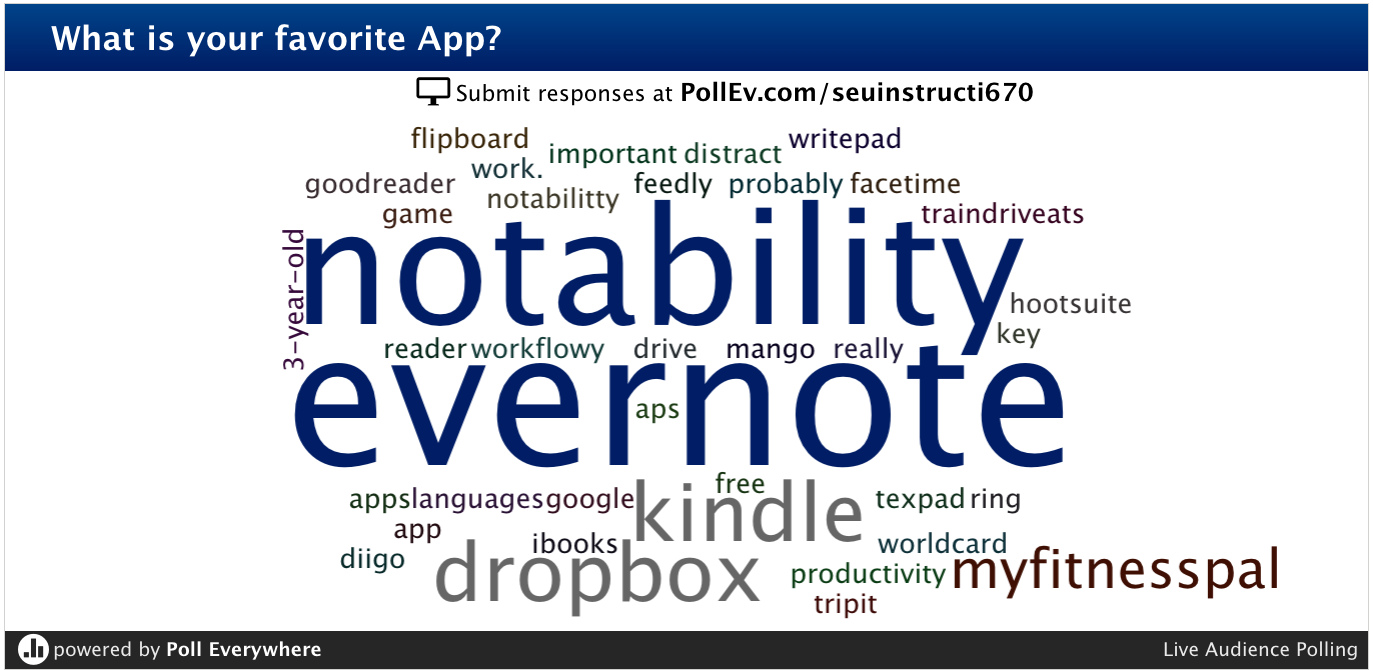
Favorite Apps Word Cloud

Once again it looks like the leading apps—Evernote and Notability—are for note taking.  In addition to a split in the room based on favorite note-taking app, we also saw a split between those who use a stylus vs. those who use a keyboard.  We’ll dive into this topic in more depth at our next meeting of this community on Wednesday, October 8: “Digital Note-Taking and Management” in JBWS 180 at 3:30 pm.

My biggest take-away from the mixer is that “What is your favorite app?” is a hard question to answer; I have many favorite apps because I use mobile apps in a variety of contexts including

  • taking, organizing, and accessing meeting notes;
  • managing my to do list;
  • reading for work;
  • tracking my calories and exercise;
  • sharing files across multiple devices;
  • managing my commute with traffic maps and voiceover to read to me while I drive;
  • and entertainment through videos, games, reading, and music.

So to continue the conversation begun last Wednesday, please share a list of both your favorite apps but also your favorite categories or uses of apps.  Kim Garza, one of our innovation fellows got us started by revising and sharing a blog post, “Ramping Up,” she wrote this summer during the Innovation Institute. (Thanks Kim!)  Please share your answer in a blog post or by responding in a comment.

Rebecca Frost Davis Director of Instructional and Emerging Technology Rebecca Frost Davis joined St. Edward’s in July 2013 as Director of Instructional and Emerging Technology, where she provides leadership in the development of institutional vision with respect to the use of technology in pursuit of the university’s educational mission and collaborates with offices across campus to create and execute strategies to realize that vision. Instructional Technology helps faculty transform and adapt new digital methods in teaching and research to advance the essential learning outcomes of liberal education. Previously, Dr. Davis served as program officer for the humanities at the National Institute for Technology in Liberal Education (NITLE), where she also served as associate director of programs. Prior to her tenure at NITLE, she was the assistant director for instructional technology at the Associated Colleges of the South Technology Center and an assistant professor of classical studies at Rhodes College, Denison University, and Sewanee: The University of the South. She holds a Ph.D. and M.A. in classical studies from the University of Pennsylvania, and a B.A. (summa cum laude) in classical studies and Russian from Vanderbilt University. Dr. Davis is also a fellow with the National Institute for Technology in Liberal Education (NITLE). As a NITLE Fellow, Dr. Davis will develop a literature review relevant to intercampus teaching, which will cover contextual issues such as team-teaching, teaching through videoconferencing, and collaboration; a survey of intercampus teaching at NITLE member institutions; and several case studies of intercampus teaching at liberal arts colleges, including interviews with faculty, students, support staff, and administrators. This work will be summarized in a final report or white paper to be published by NITLE. At Rebecca Frost Davis: Liberal Education in a Networked World, (http://rebeccafrostdavis.wordpress.com/) Dr. Davis blogs about the changes wrought by new digital methods on scholarship, networking, and communication and how they are impacting the classroom. In her research, she explores the motivations and mechanisms for creating, integrating, and sustaining digital humanities within and across the undergraduate curriculum.