Fashion Brand Chanel vs. Retail Giant Bergdorf Goodman: Twitter Strategies in the Luxury Retailing Industry

Last week, Jamie Waugh Luke, a columnist for Luxury Daily, posted an article about two well-known giants in the luxury retailing industry (Chanel and Bergdorf Goodman) and their different strategies on Twitter. The article, titled “Chanel vs. Bergdorf Goodman: Twitter personas and the perception of luxury,” examined both company’s Twitter pages and came to some conclusions about using Twitter in the luxury fashion industry. In this blog, I’m going to dissect the article and give specific examples to some of the conclusions that Luke came to.

First of all, the author believes that Bergdorf Goodman could take some pointers from Chanel’s social media strategy.

“Though it is inherently risky to compare brand to retailer, and though Bergdorf’s tweets read like a wink and a toast at best, it is nevertheless revealing of how the luxury retailer could learn from the writing and the strategy behind Chanel’s tweets.”
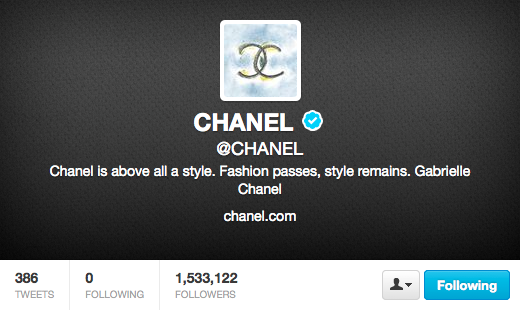
 

1)   Chanel follows no one

Luke believes that following people on Twitter is one of the key ingredients in building an engaged audience; however, this is not the case for Chanel.

“Listening does not appear to be Chanel’s bag, and I would bet the followers do not care. They do not love Chanel because it is chatty: They love Chanel because associating with the brand offers rich club membership”

2)   Bergdorf Goodman utilizes a “Twitter Persona”

Bergdorf tweets from a persona, a fun and fashionable girl, who tweets about her daily life and fashion.

“The problem with Bergdorf ’s tweets: you are often forgetting you are reading about Bergdorf… Instead, it offers the reader retweeted conversations with ordinary strangers out there who do not particularly have much to say.”

The Bergdorf Goodman Twitter has also been utilizing the hashtag #GetScattered, to promote a new documentary about the retailer debuting May 3rd.

“And the brand retweets fashionista after fashionista excited that the Bergdorf documentary is coming. The fact that Bergdorf is giddy that it is giddy casts a shadow on Bergdorf’s aura.”

3)   Chanel uses a simplistic style when composing their tweets

Chanel uses simple tweets and lets the products do all talking

“The content keeps the Chanel aficionado informed of the glamorous intrigue they want to know… I f the reader has not bought Chanel yet, there is enough emotive content here to make her ready to leap at the first chance.”

Luke believes that Bergdorf Goodman is not completely failing. The “elevated” and “polite humor” that BG uses in its tweets is relatable to the 175 thousand+ followers.

However, brand voice is still the central idea that all fashion PR specialists should keep at the front of the brain when managing a brand or retailer’s social media outlets.

“THERE IS something to be said for using social media to integrate a brand into a person’s lifestyle. But when that means forgetting about the brand’s life itself, the message gets lost –and perhaps customers do as well.”

Luxury Fashion Brand DKNY in Copyright Controversy with Popular NYC Blog

Last week, luxury retailing brand DKNY got themselves in a bit of a pickle.

Here’s what went down:

DKNY approached well-known blogger, Brandon Stanton, to discuss using his photographs for promotion in their stores. Stanton runs the popular art blog, Humans of New York, which chronicles the diverse cultures of New York City and its eccentric residents through photographs.

DKNY offered Stanton $15,000 for the rights to use 300 of his photographs in their retail stores around the world. Stanton believed that $50 per photo was not enough and declined their offer.

Then things went south.

On February 25th, Stanton updated the Humans of New York Facebook page with a photo attached. Here is what the status read:

“I am a street photographer in New York City. Several months ago, I was approached by a representative of DKNY who asked to purchase 300 of my photos to hang in their store windows “around the world.” They offered me $15,000. A friend in the industry told me that $50 per photo was not nearly enough to receive from a company with hundreds of millions of dollars of revenue. So I asked for more money. They said “no.”

Today, a fan sent me a photo from a DKNY store in Bangkok. The window is full of my photos. These photos were used without my knowledge, and without compensation.

I don’t want any money. But please SHARE this post if you think that DKNY should donate $100,000 on my behalf to the YMCA in Bedford-Stuyvesant, Brooklyn. That donation would sure help a lot of deserving kids go to summer camp. I’ll let you guys know if it happens.”

Within four hours, DKNY posted this response on their Facebook page:

DKNY’s response to Humans of New York

Soon after, Stanton responded back on the Humans of New York page

Humans of New York’s response to DKNY’s apology

How do you think DKNY handled this situation? Would you have done anything differently?

PR and Social Media’s Opportunity to Improve Accessibility to Fashion

In the January 2013 issue of W Magazine, (one of the leading luxury-fashion magazines in the world) editor-in-chief Stefano Tonchi wrote in his editor’s letter:

“At W, we believe that art and fashion are two of the most important contemporary cultural forces.”

Fashion has a large influence on society and culture; however, fashion is often dismissed as frivolous or obnoxious.

In the fashion documentary The September Issue, Anna Wintour (editor-in-chief of Vogue) said

“ I think what I often see is that people are frightened of fashion. Because it scares them or makes them feel insecure—they put it down. On the whole people that say, demeaning things about our world I think that’s usually because they feel, in some ways, excluded or, you know, not a part of ‘the cool group’ so as a result they just mock it.”

Anna Wintour is correct, unfortunately. The fashion industry has historically been extremely exclusive. Only a margin of the population can enjoy fashion and have access to it.

This is where PR and social media have a huge opportunity. Fashion is such a giant cultural force, but few in our society have access to enjoy it and this margin dominates the industry.

PR and social media in the luxury-retailing world face a dilemma: to focus on this margin and continue the exclusivity of the industry, or, utilize the power of PR and social media and make fashion more accessible to the rest of society.

Social media is extremely important for the fashion industry. Data aggregator website, Starcount, collects information on social media engagement about celebrities, sports teams, brands, and others topics of interest. During the week of January 28th – February 3rd 2013, fashion brands Michael Kors, Dior, Louis Vuitton, and Chanel were all in the top 10 of trending brands.

Social media allows a brand to engage with consumers and become more personable. PR professionals can utilize this strength to remove the exclusivity of fashion to consumers and increase consumer interest.

In The September Issue, Anna Wintour also said: “There is something about fashion that can make people really nervous.”

PR and social media have the ability to challenge this idea and create more positive brand equity for fashion labels and luxury-retailers.