
France is one of the top countries known for its sustainability and in leading the fight against climate change. It has legislation that makes it mandatory for everyone in the country to take part in making the country eco-friendly and to help conserve energy. The French have implemented and continue to implement new policies and projects to help them reach their sustainability goals. During my time in France, I noticed lots of differences between the U.S. and France, some of these I think the U.S. should start doing to help us become a more sustainable country. The French are turning towards mixed use development and pedestrianizing areas to help them become more sustainable.
Mixed Use Development
France is an old country with most of its cities already having its designs, but with a need to expand. So how do French cities expand while keeping intact their architectural history and continue to be eco-friendly? Well, the answer is, mixed use development.

Pedestrianized city center in Strasbourg with mixed use development. Photo credits: Cynthia Velasquez
By adopting the mixed use development technique, the French are mixing residential, commercial, and leisure areas. This technique solves many of the problems that they were facing with the idea of expanding outwards. For example, the downtown or city center of the city of Angers, is full of mixed use buildings. It contains a mixture of 3-5 story high buildings and all serve different purposes. Some buildings house pharmacys, restaurants, bars, offices, and retail stores in the first and second floor, and the remaining floors serve as apartments. Mixed use development allows for architectural designs of buildings to remain and offers more residential options to people. You might be asking and what does this have to do with sustainability? Well, mixed use development gives people access to more things within a closer proximity that otherwise wouldn’t be near. This technique will encourage people to walk and get what they need since things are closer now, rather than driving. The less amount of driving is done, the less carbon emissions that are produced. For example, in Austin I drive everywhere because the city is so big and where I live there’s hardly any mixed use development. If I were to walk to the store it would probably take me about 40 minutes to get there. Mixed use development is convenient for people and is a sustainable way of life.
Pedestrianized areas
France and the U.S. differ greatly when it comes to having car friendly cities and being sustainable. So why do they differ and how? Well, the widths of the streets and primary modes of transportation in each of the countries play a huge role in this.
France contains less car friendly cities, yet more sustainable cities. France is an older country with narrow roads because when its cities first began to form cars hadn’t been invented. Since there were no cars people had to walk, ride horses, or travel by wagon to their desired destination, this led people to remain close to their essentials. On the other side, we have the U.S., a country known for its car friendly cities, but known for its high carbon emissions. The U.S. contains larger roads which can be traced back to the invention of the car and its large amount of available land for expansion.
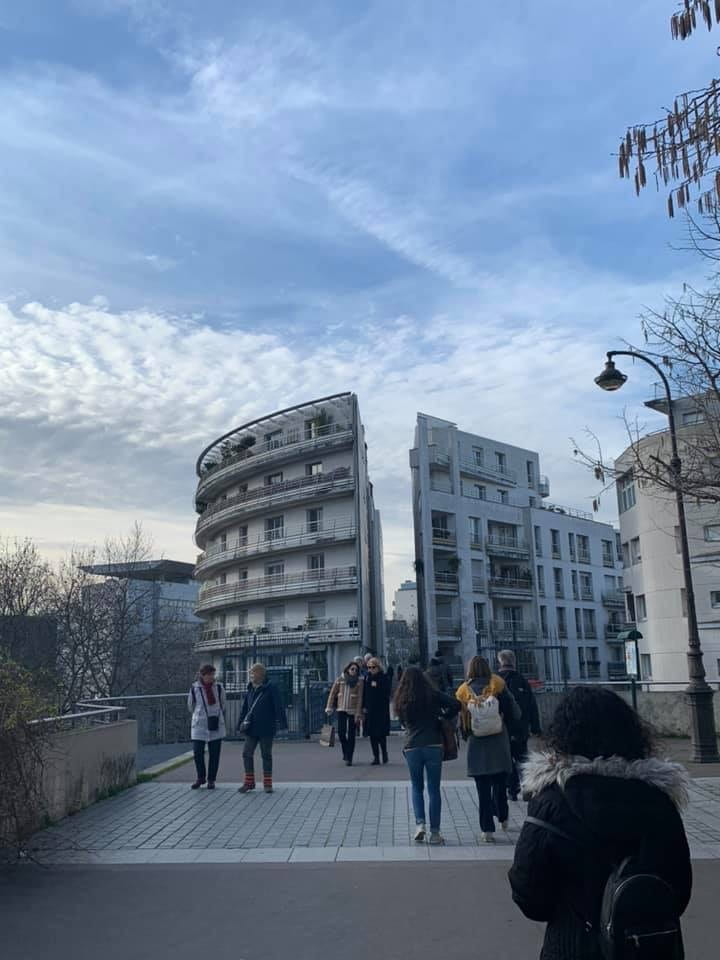
Pedestrianized area in Paris. Photo credits: Cynthia Velasquez
Even with the popularization of cars, France remains using other forms of transportation and has conducted several sustainability projects to help maintain low carbon emissions. The one thing that stood out to me during my time in France was its pedestrianized streets and areas. Many cities in France contain narrow streets which only allow for the street to serve as a one way street. Instead of expanding streets, French cities decided to pedestrianize many of its cities, especially those near the city center. Pedestrianized streets means people are allowed to walk in the middle of the road and most cars are prohibited entry unless they have been granted access. By prohibiting entry to most cars, people feel safer walking in the street without having to watch out for cars. In France, pedestrianized streets and areas are full of people enjoying a nice time and often encourages others to do the same.

Pedestrianized street in Paris. Photo credits: Cynthia Velasquez
The U.S. is considered a leading country but we sadly aren’t a leader in sustainability. France has implemented some great sustainability techniques, policies, and projects that the U.S. itself should take a few notes on. Becoming a sustainable country is not easy and it does take lots of money, but in the long run we are helping the environment and benefiting ourselves from it. Mixed use development and pedestrianizing areas are just two of things we can implement that can help us lower the amount of carbon emissions we produce. We’re seeing the effects of climate change throughout the world so reducing greenhouse gas emissions is very important right now. We should consider becoming a more sustainable country.
Blog post by Cynthia Velasquez.
Works Cited:
/https://www.sandbirch.com/cop21-spurs-frances-ecodistrict-developments-but-lacks-neighborhood-connectivity/
https://www.jll.cl/es/trends-and-insights/cities/how-paris-is-betting-on-mixed-use-development
https://ec.europa.eu/environment/pubs/pdf/streets_people.pdf
https://ggwash.org/view/43383/three-examples-of-great-street-design-in-france